The End of the Cluster Era? 🦆
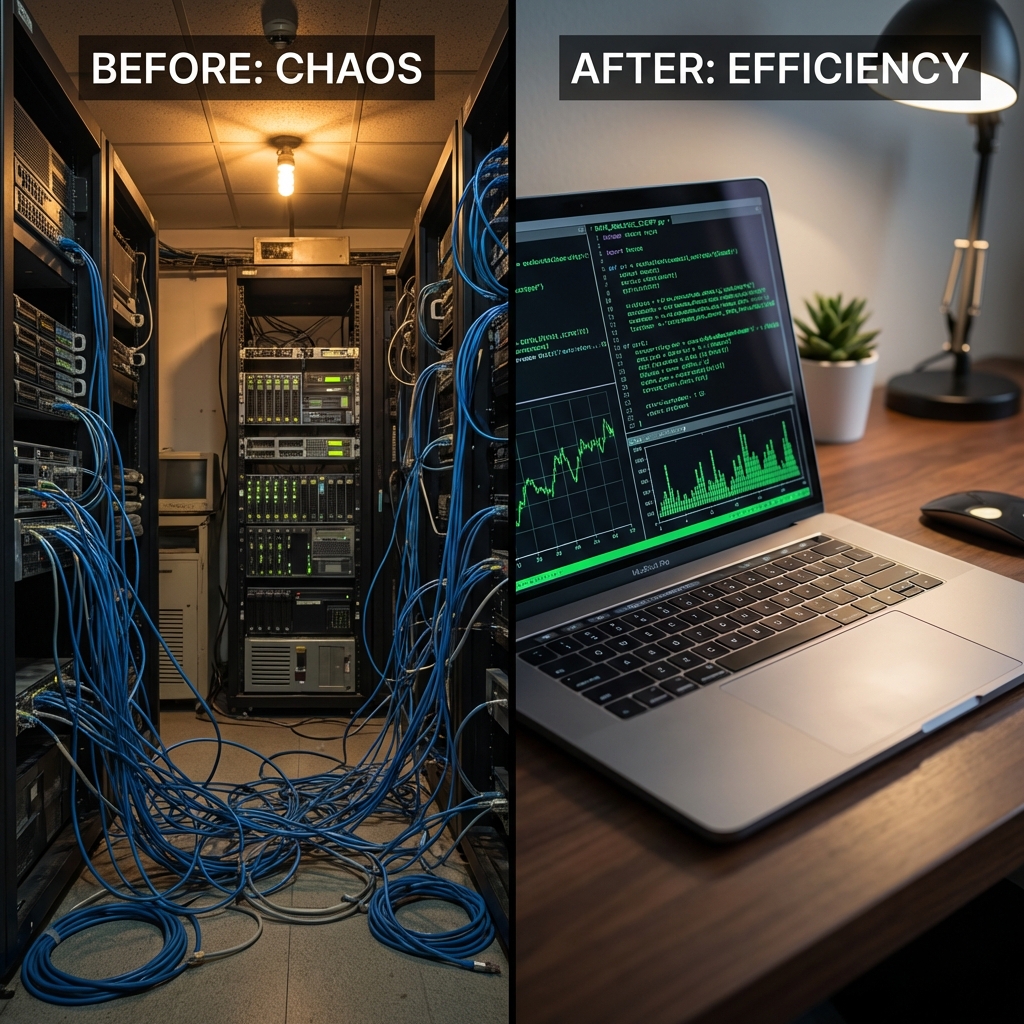
For the past decade, the mantra was clear: Big Data requires Big Infrastructure. Need to process a few hundred gigabytes? Spin up a Spark cluster. Running some aggregations? Better configure those Hadoop nodes.
But something has shifted. In 2026, I'm processing 100GB datasets on my MacBook Pro—faster than the Spark cluster we had at my previous company.
Welcome to the era of small, fast, and cheap data processing.
The Problem with "Big Data" Infrastructure
Let's be honest about what distributed computing actually costs:
| Hidden Cost | Reality |
|---|---|
| Infrastructure | Cloud clusters are expensive—even "small" EMR jobs cost $10-50/hour |
| Complexity | Spark requires expertise in JVM tuning, shuffle optimization, and cluster management |
| Latency | Spinning up a cluster takes minutes; debugging takes hours |
| Iteration Speed | Slow feedback loops kill data science productivity |
Most "Big Data" workloads aren't actually that big. Studies show that 80% of analytics workloads process less than 100GB of data. For these workloads, distributed computing is pure overhead.
Enter the New Stack
DuckDB: The SQLite for Analytics
DuckDB is a columnar, in-process analytical database that runs entirely in your application. No server, no configuration, no cluster management.
It leverages modern hardware effectively:
- Vectorized query execution for CPU cache efficiency
- Parallel processing across all your cores
- Direct querying of Parquet, CSV, and JSON files
The killer feature? You can query a 50GB Parquet file with a 10-line Python script:
- Read directly from S3 or local files
- No data loading or ETL required
- Results in seconds, not minutes
This changes the economics of analytics completely. What previously required a data warehouse now runs on a laptop.
Polars: Pandas, But Actually Fast
Pandas has been the workhorse of Python data science for over a decade. But let's be honest—it's slow, memory-hungry, and doesn't utilize modern hardware.
Polars is the Rust-based replacement that fixes all of this:
| Feature | Pandas | Polars |
|---|---|---|
| Speed | 1x baseline | 10-100x faster |
| Memory | 5-10x data size | ~2x data size |
| Parallelism | Single-threaded | Multi-threaded by default |
| Lazy Evaluation | No | Yes (query optimization) |
The key innovation is lazy evaluation. Instead of executing operations immediately, Polars builds a query plan and optimizes it before execution—just like a database query optimizer.
Real-world impact: A data pipeline that took 45 minutes with Pandas now runs in 2 minutes with Polars. Same code structure, same operations, 20x faster.
Apache Iceberg: The Lakehouse Table Format
The final piece of the puzzle is Apache Iceberg—an open table format that's becoming the standard for organizing analytical data.
Why does the table format matter?
- Schema Evolution: Add, drop, or rename columns without rewriting data
- Time Travel: Query data as it existed at any point in time
- Partition Evolution: Change partitioning strategy without data migration
- ACID Transactions: Concurrent writes without corruption
Iceberg works seamlessly with both DuckDB and Polars. Your laptop becomes a mini data lakehouse.
The New Workflow
Here's what modern data science looks like in 2026:
1. Store data in Parquet/Iceberg on S3 or local disk
- No database servers to manage
- Pay only for storage (~$0.02/GB/month)
2. Query with DuckDB for SQL analytics
- Instant startup
- Direct file access
- Results in seconds
3. Transform with Polars for complex pipelines
- Lazy evaluation for optimization
- Multi-threaded by default
- Memory efficient
4. Deploy anywhere
- Lambda functions
- Local scripts
- Jupyter notebooks
- CI/CD pipelines
The infrastructure cost? Near zero. The complexity? Minimal.
When You Still Need Distributed Computing
Let's be clear: distributed computing isn't dead. You still need Spark/Dask/Ray when:
- Processing petabyte-scale data
- Running machine learning training across GPUs
- Building real-time streaming pipelines
- Handling extremely wide joins across massive tables
But for 80% of data science workloads—exploratory analysis, feature engineering, model validation, reporting—the new single-node stack is faster, cheaper, and simpler.
The Economic Shift
This matters beyond just technical convenience. Consider the implications:
- Startups can build sophisticated data platforms without cloud bills measured in thousands
- Data scientists can iterate 10x faster without waiting for cluster provisioning
- Small teams can compete with enterprises on analytical capability
- Local-first workflows enable offline development and testing
The democratization of data processing is real, and it's happening now.
Getting Started
Want to try this stack? Here's the minimal setup:
1. Install the stack:
- Python 3.10+
- pip install duckdb polars pyarrow
2. Your first DuckDB + Polars pipeline:
- Use DuckDB for SQL aggregations directly on Parquet
- Use Polars for DataFrame operations on the results
- No servers, no clusters, no configuration
3. Scale up (if needed):
- MotherDuck for cloud-hosted DuckDB
- Polars Cloud for managed transformations
- Apache Iceberg for multi-engine table management
The Future is Local-First
The trend is clear: bring the compute to the data, not the data to the compute. Modern hardware (M-series chips, NVMe storage, 128GB RAM laptops) makes this possible.
In 2026, before spinning up that Spark cluster, ask yourself: "Can I just use DuckDB?"
The answer is probably yes.
What's your experience with the modern data stack? Have you made the switch from Pandas to Polars? I'd love to hear about your benchmarks and use cases.